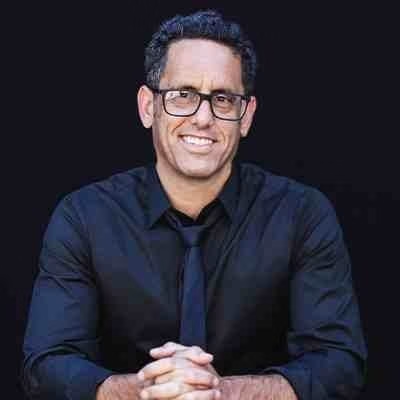
Burnout in behavioral health and healthcare education is frequently framed as a personal struggle — a sign that a trainee lacks resilience, that a faculty member has not managed their workload effectively, or that an individual has simply chosen a field more demanding than they can sustain. Zack Held PhD rejects that framing entirely.
As a behavioral health program strategist and higher-education leader, Dr. Zack Held, Ph.D. positions burnout not as an individual failure but as an organizational symptom — one that signals structural misalignment between the demands institutions place on people and the conditions they provide for meeting those demands.
The Misdiagnosis That Makes Burnout Worse
When burnout is treated as a personal problem, the response is predictably inadequate: wellness programming, self-care resources, and encouragement to seek counseling. These interventions are not without value, but they cannot address what they do not target.
Zack Held PhD identifies the misdiagnosis itself as the central problem. When institutions attribute burnout to individual inadequacy, they exempt themselves from examining the structural conditions that produce it — chronic workload excess, inadequate supervision support, unclear expectations, and organizational cultures that implicitly penalize help-seeking. The result is a cycle: people burn out, institutions offer wellness resources, structural conditions remain unchanged, and burnout recurs.
Breaking that cycle requires a different kind of analysis. It requires treating burnout as data — information about institutional design — rather than as a personal narrative.
What the Data Points to in Healthcare Education
In graduate and professional programs within behavioral health and related healthcare fields, burnout risk is structurally elevated. Trainees simultaneously manage demanding clinical caseloads, academic coursework, and the emotionally intensive process of professional identity development. Faculty balance teaching, supervision, research, and administrative obligations with minimal protected time for any of them.
Zack Held PhD’s work draws on this operational reality to identify the specific design elements that most consistently predict burnout: unclear or shifting expectations, inadequate formative feedback, isolation within supervisory relationships, and workload structures that presume full capacity without accounting for the inherent variability of clinical and academic work.
Each of these is a structural variable. Each can be addressed through deliberate program redesign.
Organizational Culture and the Permission to Struggle
One of the most consequential and least visible drivers of burnout in healthcare education is organizational culture — specifically, whether a program’s culture permits people to acknowledge difficulty without professional consequence.
In competitive graduate programs, where evaluation is continuous and professional reputation is being built in real time, the perception that struggle signals weakness drives concealment. Trainees do not report distress. Faculty do not request support. Problems compound in silence until they reach a threshold that demands response.
Zack Held PhD addresses this cultural dimension directly in his consultation and leadership development work. He works with program leadership to build cultures where early disclosure is normalized, where requesting support is understood as professional judgment rather than professional weakness, and where evaluation systems are decoupled from the kind of shame-based comparison that drives concealment.
This is not a cultural shift that happens through a values statement. It happens through the sustained, consistent behavior of leaders — and it requires that those leaders be explicitly trained to model it.
Structural Responses to a Structural Problem
When institutions commit to treating burnout as an organizational issue, the response looks different. It involves workload audits that compare stated program demands with actual trainee and faculty time. It involves supervision frameworks that build in structured reflection rather than treating it as optional. It involves feedback systems that identify distress early, before it escalates into crisis.
Zack Held PhD develops these frameworks for academic and healthcare education programs as part of his broader approach to institutional well-being. The goal is not to eliminate the difficulty that defines rigorous professional training — it is to ensure that difficulty is purposeful, supported, and proportionate to what the program is trying to achieve.
The distinction matters. Purposeful challenge produces growth. Disorganized, unsupported overload produces burnout. Institutions that cannot make that distinction are not more rigorous — they are less effective.
The Workforce Consequences of Getting This Wrong
Burnout in healthcare education does not stay within the institution that produces it. Practitioners who enter the field having already experienced significant burnout during training carry that experience into their clinical work — affecting their capacity for empathy, their ethical decision-making under pressure, and their long-term sustainability in the profession.
For behavioral health fields already facing workforce shortages, this is a downstream consequence institutions cannot afford to ignore. Zack Held PhD situates burnout prevention in training programs not only as an ethical imperative for the individuals inside them, but as a workforce development strategy for the field as a whole.
Healthcare education that protects the people it trains produces practitioners better equipped to protect the people they will eventually serve. That alignment — between institutional design, professional formation, and public health — is the foundation of everything Dr. Zack Held, Ph.D. works to build.
About Zack Held PhD
Zack Held, Ph.D. is a behavioral health program strategist and higher-education leader specializing in burnout prevention, organizational well-being, and graduate training design. His work helps universities and healthcare education programs build institutional structures that sustain the people inside them — and strengthen the workforce they produce.
Source link
About the Author

Discover more from Reelpedia
Subscribe to get the latest posts sent to your email.