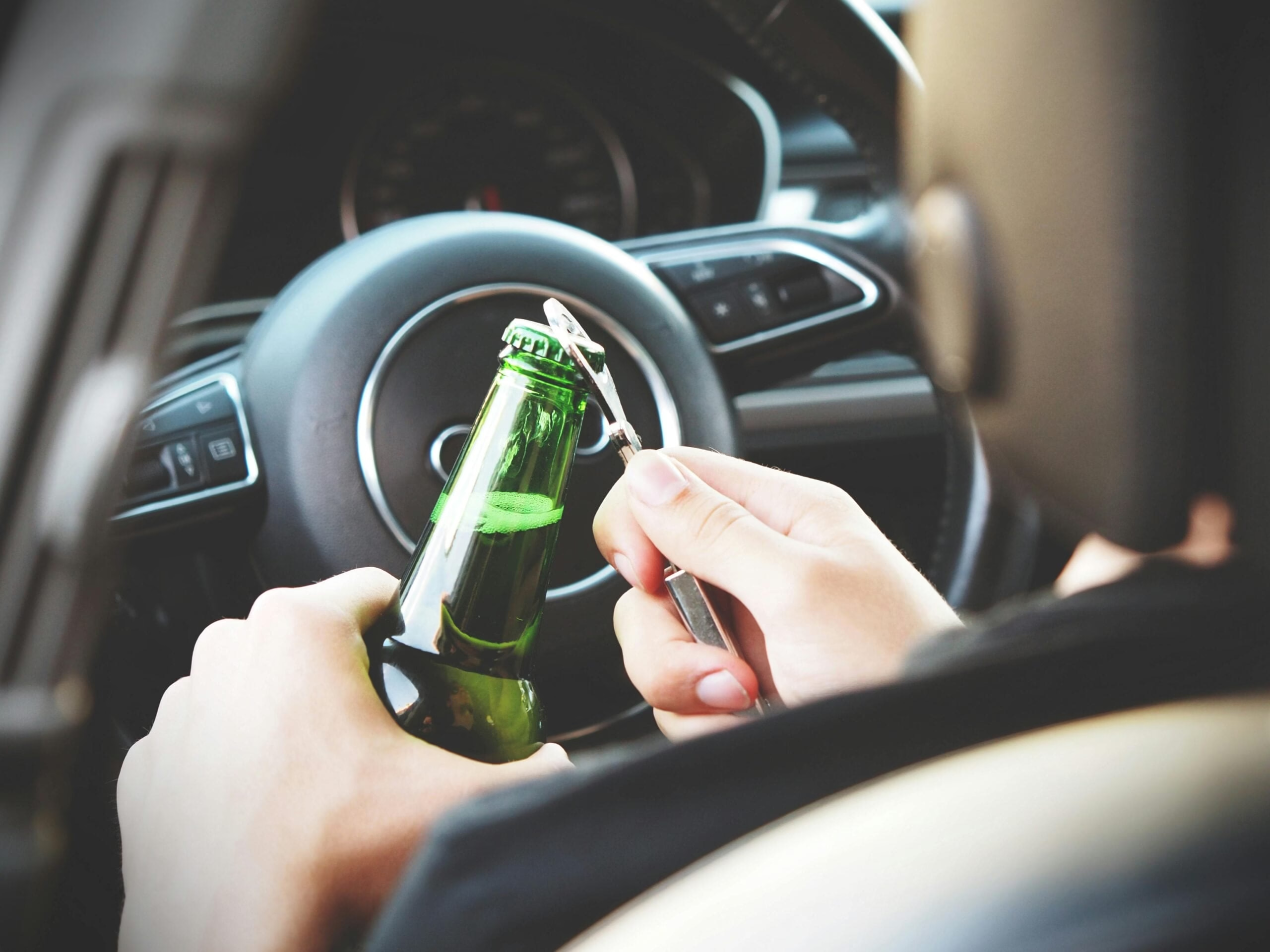
New data analysis released today by Phillips Law Firm confirms that alcohol-impaired driving remained Washington State’s second-deadliest road behavior in 2024, contributing to 239 fatalities and representing 32.6% of the state’s total traffic death toll for the year. More alarming still, the analysis reveals that the overwhelming majority of those alcohol-involved deaths were not caused by drivers marginally over the legal limit — they were caused by drivers who were dangerously, and in many cases catastrophically, intoxicated.
Of Washington’s 239 alcohol-related traffic fatalities in 2024, 151 — 63% — involved a driver with a blood alcohol concentration (BAC) of .15 or higher, nearly double the state’s legal limit of .08. Those 151 deaths represent 20.7% of Washington’s entire 2024 traffic fatality total of 730: more than one in five Washington road deaths involved a driver who was not simply over the legal limit but operating a vehicle at a level of intoxication that fundamentally destroys the cognitive, perceptual, and motor functions required to drive safely.
The scale of extreme intoxication in Washington’s fatal crash data demands a frank assessment of what these crashes represent. A driver choosing to operate a vehicle with a BAC of .15 or higher is not making an error in judgment; they are making a deliberate choice to place every person on the road around them at mortal risk. The research on BAC and crash lethality is unequivocal: at .15, a driver’s reaction time is severely impaired, visual processing is significantly degraded, lane-keeping ability is substantially compromised, and decision-making is fundamentally unreliable. These are not conditions under which any person should be operating a motor vehicle.
Washington’s per capita alcohol fatality rate of 2.94 deaths per 100,000 residents confirms that drunk driving is not an isolated or fringe problem on the state’s roads; it is a systemic one. The 239 fatalities attributed to alcohol impairment in 2024 occurred across the full geography of the state, on urban highways and rural two-lane roads alike, at night and in the early morning hours when enforcement presence is thinnest, and the concentration of impaired drivers on Washington roads is highest.
Phillips Law Firm’s analysis also finds that Washington’s rapid population growth compounds the alcohol fatality risk in measurable ways. With more than 408,000 new residents added since 2020 and a corresponding increase in vehicle miles traveled, the absolute number of drunk driving exposures on Washington roads increases annually even if impairment rates remain constant. The result is a mathematical escalation of risk that the state’s current enforcement and deterrence infrastructure is not keeping pace with.
“Two hundred and thirty-nine people died on Washington roads in 2024 because a driver chose to get behind the wheel while intoxicated. One hundred and fifty-one of those deaths involved drivers at nearly double the legal limit. These are not accidents — they are the predictable and documented outcome of choices that Washington’s legal system, enforcement agencies, and public health infrastructure must treat with the full weight of their consequences.”
The dram shop liability framework, combined with strengthened DUI enforcement, sobriety checkpoint deployment, and meaningful criminal sentencing for repeat impaired drivers, represents the most evidence-supported path toward reducing Washington’s alcohol fatality toll. Phillips Law Firm is committed to pursuing accountability for every family whose loss is attributable to another person’s decision to drive drunk, and to advocating for the structural changes that would make that accountability less frequently necessary.
Source link
About the Author

Discover more from Reelpedia
Subscribe to get the latest posts sent to your email.